Thursday, 10 March 2022

An expensive Cooke for London


A 6 inch Thomas Cooke & Sons telescope which was equatorialy mounted with a clock work drive and micrometre was purchased by Hamilton Field of Brixton, London. He was part owner of Kearns, Major & Fields, Wharfingers (owners of wharfs) of Upper Thames Street.

The telescope cost £300 which in 2022 prices would be an eye watering £40,000.


Tuesday, 8 March 2022

Another London Cooke


A telescope purchased in 1863 of 3.5 inches aperture from Thomas Cooke & Sons of York was for Richard Whiteman Fall, of 11 Kings Arms Yard, Moorgate, London. He worked for Dent, Palmer & Co, Merchants.

The telescope came with a finder, steadying rods, dew cap, vertical and horizontal screw motions, four astronomical, one day and one solar eyepiece. In red deal box.


Monday, 7 March 2022

Solar Eclipse observed from Manchester in 1867


Observations of the Eclipse of the Sun March 6th 1867 by J B Dancer, Observatory, Old Manor |House, Ardwick, Manchester.


Just before first contact my attention was unfortunately taken from the telescope, and when got to the instrument again the eclipse had commenced.

The weather was very favourable and the atmosphere remarkably steady; clouds occasionally passed over the Sun, but did not obscure the disc for any length of time.

The telescope used was 10 feet 6 inches focal length and 7.25 inch diameter. The full aperture of the object glass was employed, with a power of 50, and using diagonal glass sun prism numerous groups of faculae were visible. One spot interested me, I have already stated that the atmosphere was very steady. Indeed I have very seldom seen the edge of the Sun so free from all disturbance.

When the Moon’s edge approached the dark spot suddenly became very tremulous and lighter in colour before it disappeared behind the body of the Moon, there were no visible cloud passing at this time and the Sun’s edge was sharply defined and perfectly steady.

During the progress of the eclipse the serrated edge of the Moon was beautifully distinct. I had several telescopes directed to the Sun; some of these had 4.5 inches and some 5.5 inches diameter object glasses. The value of aperture in observing the edge of the Moon and the faculae on the Sun’s disc was very manifest when using the 7.25 inch diameter glass.


Sunday, 6 March 2022

A Cooke for Wales


In 1864 William Evans (1828-1904) from Llanerchymedd, Anglesey, who was a surgeon purchased a 3.5 inch OG for an old tube. I don’t know it this tube was a Cooke or not.

The cost of the OG was £16 and 10 shillings this was paid in three instalments of £5 and 10 shillings.


Saturday, 5 March 2022

Earthshine seen from Leeds


In March 1911 J H Elgie in Leeds saw Earthshine on the Moon. Many people who saw it thought that an  eclipse of the Moon was in progress.


Friday, 4 March 2022

The first Thomas Cooke advert


Yorkshire Gazette Saturday March 4th 1837.


T Cooke, Working Optician, &c, 50 Stonegate, Yorkshire


Mathematical and Philosophical instruments and and repaired on reasonable terms.


Tuesday, 1 March 2022

Rambling around Ursa Major 1


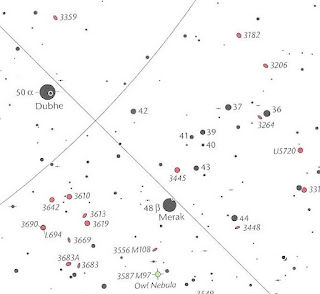
If you look close to Beta Uma or Merak one of the pointers you will see a star Flamsteed (Fl) 38 Uma then nearby a small triangle formed by the stars Fl 39,40,41 Uma.


On closer inspection it will be noted that stars 40 and 41 are to faint to be seen with the naked eye anf yet they have Flamsteed numbers.

Although Fl 40 is shown on the Star Atlas 2000 it is not listed in the Catalogue 2000 as Fl 40 but rather as HD 93075 (The HD stands for Henry Draper). It is listed in most catalogues with a magnitude of 7.1.

 This of course is below the limit of naked eye visibility. Although Flamsteed lists it as being of the 6th magnitude. So unless Flamsteed used some sort of optical aid when he was studying Ursa Major there is no way that he could have seen this star. Now of course it is possible that the star has faded in brightness. There is a variation in the spectral class of the star in catalogues, ranging from F0v to A8v.

Just for good measure Fl 41 which is listed with a magnitude of 6.3 again below the limit of naked eye visibility. The star being reported with a spectrum class of M1 III. As a very large number of red giants are variable I would not be at all surprised if this star varied. The General Catalogue of variable and suspected variables however does not list this star.