Wednesday, 21 October 2015

Astrognome Astronomy The Island of Sicily in the Night Sky

Aries and Triangulum

Triangulum (or the island of Sicily) 


Below and between Gamma and Beta Andromeda lies a fairly bright triangle of stars which is called Triangulum the Triangle. It is unusual to find a constellation that looks like the picture it is supposed to represent but Triangulum is one of those few that does.

Its brightest stars are Beta at magnitude 3.1, Alpha at magnitude 3.6 and Gamma at magnitude 4.1. There is one important object in this constellation M33 the Pinwheel Galaxy. It lies between Alpha Triangulum and Beta Andromeda. It is face on to us and can easily be seen with binoculars. I am sure that people with good eyesight can see in from very dark sites. M33 is about 3 million light years away.


In mythology Pluto king of the underworld wanted to marry Proserpina daughter of Ceres . An arrangement was made whereby she would live six months of the year below ground with Pluto and the other six months above ground. As a wedding present she was given the island of Sicily which is represented in the sky as a triangle.

Aries.

Beneath Triangulum is Aries The Ram.  This constellation was made famous by being the first sign of the Zodiac,  the point where the Sun’s yearly path amongst the stars cuts the celestial equator. Due to the shifting of the Earth’s axis this has now moved to the neighbouring constellation of Pisces. However the term “First Point of Aries “is still used today.

Alpha or Hamal at magnitude 2.0 is easy to see and is distinctly reddish in colour, the other two reasonably bright stars are Beta at magnitude 2.7 and Gamma at magnitude 4.0.


In Greek mythology, Aries represents the ram whose fleece was sought by Jason and the Argonauts. When King Athamus of Boetia took a second wife, Ino, she was resentful of his existing children, especially his son, Phrixus, and she wanted him sacrificed. Zeus responded to the pleadings of Phrixus' mother, Nephele, by sending a golden ram to save Phrixus and his sister Helle. Helle did not survive but Phrixus did and sacrificed the ram to Zeus and gave its golden fleece to King Aettes. The fleece was eventually stolen by Jason.

Monday, 19 October 2015

Astrognome Scrapbook Thomas Cooke Telescope Maker of York

Thomas Cooke March 8th 1807- October 19th 1868, Telescope Maker of York

Thomas Cooke was born in the village of Allerthorpe in the East Riding of Yorkshire on 8th March 1807.Although born into a very poor family he would go on to become one of the greatest telescope makers of all time. (He had no connection with Thomas Cook, the holiday company).  His father was a shoe maker, and it was assumed that he would join the family business.

 However Cooke had other ideas, he wanted to follow his hero Captain James Cook (no relation) in exploring the world. When ready to join a ship at Hull he was persuaded at the last minute by his mother to stay in England. To earn money he opened a village school and taught mathematics to the sons and daughters of wealthy landowners.


He moved to York in 1829 still teaching, it was then that he made his first telescope, using the base of a whiskey tumbler for a lens and some tin to make the tube. 

In 1837 Thomas Cooke opened his first shop at No. 50 Stonegate in York with a loan of £100 from his wife’s uncle. Cooke had married Hannah Milner while teaching; she had been one of his pupils.

The instrument making business was an instant success. Cooke quickly gaining a reputation for high quality. Within a short period of time he was making not only telescopes but also, Microscopes, Opera Glasses, Spectacles, Electrical Machines, Barometers, Thermometers, Globes, Sundials, Mathematical Instruments, etc.!!

By 1844 business was so good that he had to move to new premises at No 12 Coney Street, York, here the orders for telescopes kept coming in as did a new venture for Cooke, making Turret clocks.  These behemoths are about the size of a medium family car and weigh about ¾ of a ton.  They can still be found in church and factory clock towers.

In 1855 he exhibited instruments at the Universal Exhibition in Paris and visitors were much impressed. Again the orders increases and yet bigger workshops were needed. 

In 1856 The Buckingham Works was built on the site of the home of the second duke of Buckingham at Bishophill in York. It was one of Britain’s first purpose built telescope factories. Many of Cooke’s finest instruments would be made here; the factory would be used by Cookes until the 1940s.


An order for a telescope was received from Prince Albert in 1860, and a magnificent instrument was built, in recognition for this work and under order from H M commissioners Cookes` at the 1862 exhibition in London were given a very prominent position for their display, and they received an embarrassingly large amount of orders. 

Also at the great exhibition in 1862 was Robert Newall from Gateshead, a millionaire who had made his fortune making wire. He was also interested in astronomy.


He purchased two lenses 25 inches (63.5 cm) across and asked Cooke if he could make him a telescope. He said he could and that it would take a year. Unfortunately Cooke was making a rare mistake. It took not one but six years to complete, it was actually completed a year after his death. When finished the telescope tube was 32 feet (960cm) long and the whole instrument weighed 9 tons. It was the biggest telescope in the world and it had been made in York.  

Around 1866 Thomas Cooke started to produce steam cars, at least four and possibly six were produced. He used three wheels rather than four because he found it was easier to devise a steering system for just a single wheel.


 The steam cars travelled at 15 mph; unfortunately they were banned from the roads because they travelled too quickly. In those days a man with a red flag had to walk in front of any vehicle that was not pulled by a horse. The speed of a walking man is only about 4 mph. It would therefore be very dangerous to walk in front of this Steam Car.

In frustration he took the steam engine and placed it into a boat in which he travelled up and down the River Ouse. He wryly commented that no one with a red flag would bother him there.

Thomas Cooke worked incredibly hard during his life, one problem he had was he spent too much time working; sadly he literally wore himself out.

Thomas Cooke died on the 19th October 1868.

After the death of Thomas Cooke, the company was run for the next 25 years by his two sons Thomas Cooke Jnr who was an optician and Charles Frederick Cooke who was an engineer.

In 1893 H D Taylor who was Optical Manager at the Buckingham Works designed the Cooke Photographic Lens; it would become the basic design for nearly all future camera lenses.


The last major astronomical project, a large transit instrument for the Greenwich Observatory began in 1932, it proved to be a disaster for Cooke’s. The company was hit hard by the great depression in the early 1930s and many of their skilled workers were laid off.

In 1938 Cookes sold the astronomical side of the business to Grubb Parsons of Newcastle. A new factory the Haxby Road site was built in 1939. In 1948 the Buckingham Works was sold to the Northeastern Electricity Board.

On the 1st January 1963 a new company Vickers Instruments was formed and replaced Cooke Troughton and Simms as a trading company.


Sunday, 18 October 2015

Astrognome Astronomy Andromeda

Andromeda

Linked with Pegasus is Andromeda, the princess of the legend in which Perseus, Cassiopeia, Cepheus and Cetus all have important roles. Andromeda’s main stars are arranged in a rough line of stars from the square of Pegasus towards Perseus. 


Alpha or Alpheratz is the ‘stolen’ star from the square of Pegasus is of magnitude 2.1 then moving towards Perseus from Alpha there is Delta magnitude 3.2, Beta magnitude 2.0 and Gamma magnitude 2.1.

The most famous object in Andromeda is Messier 31 (M31) the Andromeda Galaxy.  This is the most distant object that can be seen with your eye without using an optical aid!! M31 is around 2.2 million light years away.


To find M31 locate Beta or Mirach then look upwards towards two fainter stars Mu magnitude 3.9 and Nu magnitude 4.4.  The Andromeda Galaxy lies close to Nu. If you struggle with very dark observing sites M31 can easily be seen in binoculars.


It was only after World War 1 that astronomers realised that the Andromeda Nebula as it was known as was not in our galaxy. It was a galaxy in its own right.  It was Edwin Hubble in 1923 that realised that the Andromeda Galaxy might be about 750,000 light years away. This figure was re defined in 1952 by Walter Baade to be about 2.2 million light years.

Wednesday, 14 October 2015

Astrognome Astronomy The Old North Star

The Old North Star

The North Star today is alpha Ursa Minor (the Small Bear) its name is Polaris and is the brightest star in the group. It marks the end of the tail of the small bear. To find it you have to find the pointers in Ursa Major (the Large Bear) then draw a line through them until you reach a bright star all on its own this is Polaris the North Star.


When the great pyramids were built in Egypt Polaris was not the North Star the much fainter Thuban in the constellation of Draco the Dragon had that honour. It was closest to the pole in around 2800 BC.

Although Thuban is alpha Draco it is not the brightest star in Draco. It is in fact only the 8th brightest. It is an A class giant star making it appear white in the sky,  lying at a distance of about 300 light years from Earth. Thuban can be found between the tail of the Big Bear and Kocab the fairly bright red star in Ursa Minor.


There is a suspicion that Thuban might vary in brightness, when Bayer catalogued the constellation s in 1603 it must have been brighter than Gamma which is now the brightest star in Draco.


The Earth wobbles very slightly over a period of about 26,000 years. So a line drawn from the north pole of the Earth and pointed into space will change during time.
As we have seen around 5,000 years ago Thuban was the north star, today it is Polaris in Ursa Minor, moving forward to the year 14,000 AD it will be the bright star Vega in Lyra one of the summer triangle stars that will be the north star.


Tuesday, 13 October 2015

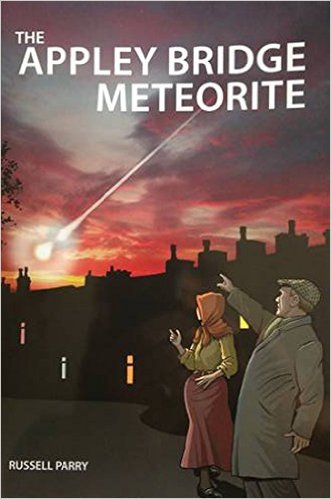
Astrognome Scrapbook Appleby Bridge Meteorite

Appleby Bridge Meteorite

It was 1914; World War 1 was in its first year when an event occurred at Appleby Bridge near Wigan in Lancashire, England, a visitor from outer space,  a meteor crashed to the ground.


It was the evening of Tuesday 13th October 1914 around 8.45 pm when local residents heard a thunderous detonation and saw a sudden and spectacular brightening of the night sky.

Many may have thought it was some kind of secret enemy weapon coming towards them from a Zeppelin airship. It was nothing whatsoever to do with the enemy but a meteorite.


On the following day an unusual stone was found embedded into the ground at Halliwell Farm. It was a Chondrite meteorite. It weighed 33 pounds (15 Kg) and was covered in a burnt powder with an interior of light grey spots of gold and metal.

Monday, 12 October 2015

Astrognome Astronomy UV Ceti

UV Ceti

Not far from Tau Ceti is the prototype star for a class of red dwarf stars that can dramatically brighten in a very short period of time. This is UV Ceti. These are sometimes referred to as Flare Stars.


These are red dwarf stars with a mass of only a few tenths of that of the Sun. They are much cooler and dimmer than the Sun. Due to them being very faint they are not easily found and most are seen within 50 or so light years from the Sun.

UV Ceti is about 8.4 light years distant and normally is of magnitude 12 however it has been known to flare up in brightness to magnitude 6.8 in around 20 seconds before fading away again. 


It is thought that this brightening could be caused by massive flares on these stars. These flares are totally unpredictable and at most will only last for a few minutes. If you are looking in near Tau Ceti through binoculars and suddenly a star appears you could be watching a flare from UV Ceti.


Sunday, 11 October 2015

Astrognome Astronomy Tau Ceti

Tau Ceti

In Cetus there is an unremarkable looking star of magnitude 3.5 called Tau Ceti. It’s a dwarf star with a type G spectrum similar to that of the Sun. In fact it is the closest solitary G type star to the Sun. It is somewhat smaller and is less massive than the Sun and lies about 12 light years.


In December 2012 astronomers discovered evidence to suggest that there are 5 planets orbiting Tau Ceti. 


Whether any of them would be able to support life is unknown. In 1960 Project Ozma was begun looking for evidence of life around other stars and Tau was on the list of stars to monitor.


 However it would be very ironic if life was discovered there in the future because Tau Ceti has been a popular destination for science-fiction writers including Arthur C Clarke, Robert Heinlein and Larry Niven and has been mentioned in Star Trek and Dr Who, plus many other films, TV programmes and Books.