The Astronomy Show 18.11.19
On the Astronomy Show today I will be looking at news that Ultima Thule which was visited by the New Horizons mission and is the most distant object visited by a space mission has a new name. The small Kuiper Belt object will now be called Arrokoth.
I will take a look at the night sky not just for the next 7 nights, there will be a very close conjuction of the planets of Jupiter and Venus later this week. I will also take a look at what we can see during the rest of autumn.
The latest news stories this week include signs of the new solar cycle 25 has started and that a possible new dwarf planet in the solar system has been identified.
Other regular features include the astronomical scrapbook looking at events that happened this week in history include in 1783 the discovery of a comet by Edward Piggot in York and the first transit of Venus being observed in 1639. All this plus news from the astronomical societies of the north of England.
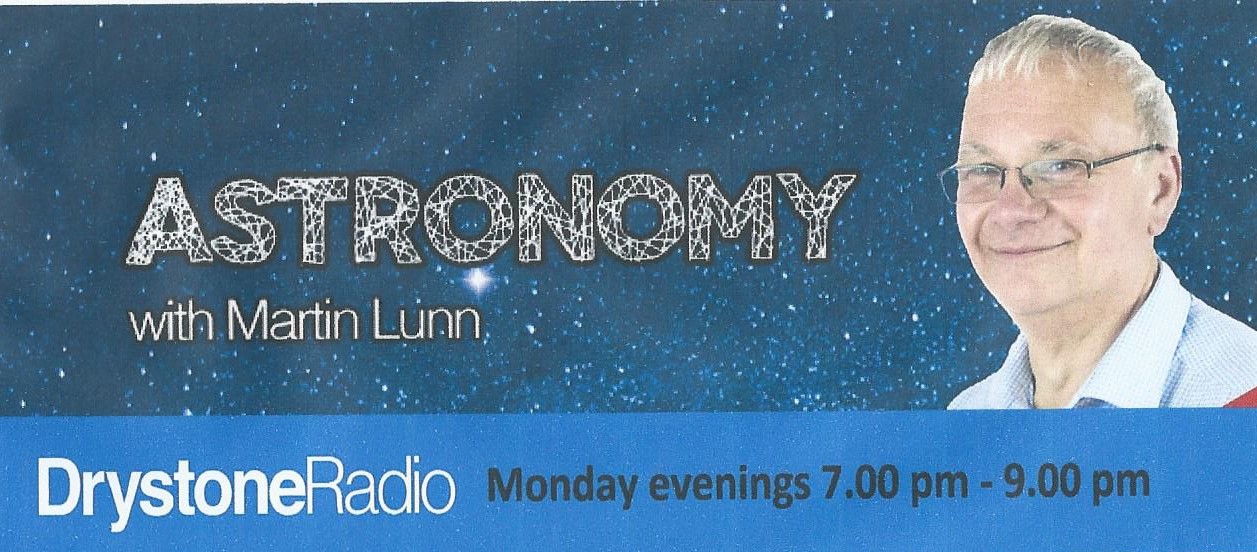
The Astronomy Show every Monday evening between 7.00 pm and 9.00 pm only on Drystone Radio 103.5 FM. The programme can be heard live on line at www.drystoneradio.com, the astronomy show can also be heard on the Drystone Radio podcast.
The next Astronomy Show will be on Monday 2nd December.
Monday, 18 November 2019
Monday, 28 October 2019
The Astronomy Show 28.10.19
The Astronomy Show is back following my latest break to present some lectures in Iceland and to observe the Northern Lights, I have been very lucky so far, over the last 2 years I have been on 4 northern light cruises and seen the northern lights 4 times!!!
However back to the hear and now and the show today, I will be looking at news that the Antartic ozone hole is the smallest on record and I will be looking at what this means.
There will the regular features including the night sky not only for the next 7 nights but also for the night sky during this autumn including a rather rare day time event with a transit of Mercury occuring on November 11th. The latest astronomy news includes details of 20 new moons being discovered around Saturn and that Venus may not have been as Earth like as scientists thought.
The astronomical scrapbook looking at events that happened this week in history includes in 840 Louis of Bavaria dying of fright during an eclipse, 1935 the Mills Observatory opened in Dundee and in 1938 Orson Wells read the War of the Worlds on American radio and convinced Americans that the Martian were invading. This plus news from the astronomical societies of the north of England.
The Astronomy Show every Monday evening between 7.00 pm and 9.00 pm only on Drystone Radio 103.5 FM. The show can be heard live on line at www.drystoneradio.com or you can hear the show later on the Drystone Radio podcast.
The next Astronomy Show will be on Monday 18th November 2019.
_
Monday, 23 September 2019
The Astronomy Show 23.09.19
On the Astronomy Show today I will be looking at what happened to the Indian moon mission Chandrayaan 2, contact was lost just before it was due to land on the Moon, the orbiter part of the mission is still working normally.
In addition to the normal weekly round up of the night sky and with Autumn now approaching this is a good time to take a look at the constellations that can be found in the night sky during autumn season.
The regular feartures include astronomy news stories including a possible interstellar comet entering the solar system, the latest news from the Yutu 2 Chinese rover on the Moon and why Jupiter's moon Io might not have a magma ocean after all. The astronomical scrapbook looking at events that happened this week include in 1846 the discovery of Nepture, the loss of the Mars Climate Explorer in 1999 and Edward Piggot discovered the variable star R Scutum in 1795. All this plus the round up of news from the astronomical societies of the north of England.
The Astronomy Show every Wednesday between 7.00 pm and 9.00 pm only on Drystone Radio 103.5 FM. The programme can be heard on line at www.drystoneradio.com the show can also be heard later on the Drystone Radio podcast.
The next Astronomy Show will be on Monday 28th October
Monday, 2 September 2019
The Astronomy Show 02.09.19
As we enter September the nights become longer and astronomers start to get ready for the new observing season. On the Astronomy Show tonight I will be looking towards the Septemebr skies when we experience the change over from summer to autumn skies. In addition the longer nights mean that Northern Lights or the Aurora Borealis have returned to the northern hemisphere.
I will be looking at news that Io the the closest of the four Galilean moons of Jupiter and often referrd to as the pizza planet is the most volcanic object in the solar system. In fact Io is superactive when it comes to volcanoes but a question being asked by astronomers is this. Do the volcanoes run like clockwork? The Astronomy Show will take a look.
The regular review of the astronomy news stories includes, the latest pictures from China's Chang'e 4 on the far side of the Moon, both the European Space Agency and Russia are experiencing problems with their parachute systems for landing space craft on Mars. Astronomers have discovered a second planet orbiting beta Pictoris and its huge.
The astronomical scrapbook which looks at dates in history this week includes in 1752 the introduction of the Gregorian calendar, in 1976 Viking 2 landed on Mars and in 1977 Voyager 1 was launched. There will be the regular round up of news from astronomical societies in the north of England.
The Astronomy Show every Wednesday evening between 7.00 pm and 9.00 pm only on Drystone Radio 103.5 FM, you can her the show live on line at drystoneradio.com or listen later on the Drystone Radio podcast.
Monday, 19 August 2019
The Astronomy Show 19.08.19
The Astronomy Show is back! Following my latest break presenting astronomy lectures on a cruise ship. It was very hot in the Mediterranean but we had some great fun with large numbers of peole attending the talks plus some stargazing evenings. The sky was so clear. On one occassion 200 people saw the Milky Way very clearly. It was amazing.
However back to the here and now, the Astronomy Show tonight will be looking at a story that NASA fed Apollo 11 moon rocks to cockroaches and then things became even more weirder. I will be finding out what happened.
I will take another extensive look at the night sky not just for the next seven nights but for the rest of the summer. Jupiter and Saturn are still visible in the evening sky although from Britain they are seen very low in the sky in the south. If you are up early in the morning you can just catch a glimpse of Mercury in the south east about an hour before the Sun rises.
The Astronomy news round up includes details of thousands of Tardigrades, which are microscopic creatures are now starnded on the Moon following the crash earlier this year of the Israeli Moon mission. Another impact on the Moon was the tiny Chinese orbiter Longjang 2, although this crash was intended, and how Venus turned into hell and how the Earth is next!
The astronomical scrapbook looking at events that happened this week in history include in 1960 the Russian dogs Strelka and Belka are the first ceatures sent into space and safely returned, in 1977 Voyager 2 was launched and in 2006 Pluto became a dwarf planet. There will also be the usual round up of news from the astronomical societies in the north of England.
The Astronomy Show only on Drystone Radio 103.5 FM, every Monday evening between 7.00 pm and 9.00 pm. The show can be heard live on line at www.drystoneradio.com or you can listen to the programme later on the Drystone Radio podcast.
Monday, 15 July 2019
The Astronomy Show 15.07.19
On the Astronomy Show today there will be a big focus on the Moon for the reason that we are very close to the 50th anniversary of the Apoll 11 landing with Neil Armstrong and Buzz Aldrin walking on the Moon. With this in mind our lead story today is about the Moon with news that India is planning to lauch their second mission to the Moon, this is the Chandrayaan 2 mission and if successful India will become the fourth country to make a soft landing on the Moon.
There will be the regular round up of what is happening in the night sky this week, the Moon attracts the atention again because there will be a partial eclipse of the Moon on the 16th July, this will be visible from Britain. The giant planets Jupiter and Saturn can still be seen as soon as it becomes dark.
The usual round up of astronomy news includes details of the launch of the Spektr-RG Russian X Ray telescope, and the Japanese Hayabusa 2 mission which has grabbed a second sample from the Ryugu asteroid. The astronomical scrapbook looking at anniversaries this week is dominated by the Apollo 11 Moon landing but other events were happening including in 1994 comet Shoemaker Levy 9 started to crash into Jupiter. All this plus the round up of news from the astronomical societies in the north of England.
The Astronomy Show, every Monday evening between 7.00 pm and 9. 00 pm only on Drystone Radio 103.5 FM. The show can be heard live on line at www.drystoneradio.com or you can listen to the show later on the Drystone Radio podcast.
Monday, 8 July 2019
The Astronomy Show 08.07.19
On the Astronomy Show today I will be looking at news that the Euro Mars Lander suffered damamge during testing when its parachute failed to deploy properly. Mars has been the planet where around half the missions have failed and having a parachute system not working correctly is a recipe for another disaster, engineers will be checking to see what happened.
I will be taking my usual look at what can be seen in the night sky during the next 7 nights including details of how to find Saturn which is now at its best and news that the first sunspots of the next cycle have been seen.
The astronomy news includes details that scientisit have found that mould found on the International Space Station is very hard to kill in space and another mysterious deep space flash has been observed, this time its host galaxy has been traced.
The astronomical scrapbook looking at anniversaries that occured this week include in 1979 Voyager 2 reached Jupiter, Telstar was launched in 1962 and in 1965 Mariner 4 reached Mars, there will also be the usual round up of news and events from the astronomical societies of the north of England.
The Astronomy show every Monday evening between 7.00 pm and 9.00 pm only on Drystone Radio 103.5 FM. You can hear the show live on line at www.drystoneradio.com or listen to the show later on the Drystone Radio podcast.
Subscribe to:
Posts (Atom)